
Table of Contents
- Key Takeaways: Quick Facts About San Diego Supplemental Taxes
- Introduction to the 2026 San Diego Supplemental Tax Landscape
- Author Credentials: San Diego Military Relocation Specialists
- Transparency and Financial Disclosure
- Understanding the Supplemental Property Tax in San Diego
- Difference Between Property Tax and Supplemental Tax San Diego
- Why Do I Have to Pay Supplemental Tax in San Diego?
- San Diego County Supplemental Property Tax Rates and Calculation for 2026
- How to Calculate Supplemental Property Tax San Diego
- Using a San Diego Supplemental Tax Calculator 2026
- Negative Supplemental Tax: Can You Get a Refund?
- Paying Your Bill: Escrow, Due Dates, and Frequency
- Can I Pay Supplemental Tax Through Escrow San Diego?
- When is the San Diego Supplemental Tax Bill Due?
- How Many Supplemental Tax Bills Will I Get in San Diego?
- The AI Gap: The Military Homebuyer’s Reality with Supplemental Taxes
- Frequently Asked Questions
- Limitations, Alternatives, and Tax Appeals
- Conclusion: Navigating San Diego Real Estate with Arrive Realty
Key Takeaways: Quick Facts About San Diego Supplemental Taxes
- What is the San Diego supplemental tax bill? It is a retroactive tax bill based strictly on the difference in property value from the previous owner’s assessment to your new purchase price.
- Escrow Exclusions: It is usually NOT collected in standard escrow impound accounts; you must pay it directly to the county.
- Timing: Bills typically arrive in the mail 3 to 9 months after your closing date in a separate envelope from the county.
- Frequency: Depending on the month you close on your home, you will receive either one or two supplemental bills.
- Negative Bills: If you purchase a home for less than its current assessed value, you will receive a “negative” supplemental bill, resulting in a refund check.
Introduction to the 2026 San Diego Supplemental Tax Landscape
Nothing dampens the excitement of homeownership quite like receiving an unexpected tax bill for thousands of dollars months after you have unpacked. The 2026 San Diego County real estate market continues to see steady appreciation, meaning the gap between a long-time seller’s assessed property value and your new purchase price is often substantial. This gap triggers the supplemental property tax.
As local market dynamics shift, understanding these hidden costs is critical for your financial planning. We highly recommend reviewing the Home Buyer Guide: Arrive Realty’s San Diego Home Buying Tips to properly budget for your total cash-to-close and post-closing liabilities.
At Arrive Realty, we specialize in supporting military personnel and growing families through these complex transitions. We frequently see buyers caught off guard by this specific tax because out-of-state lenders fail to explain it. Our goal is to ensure you are fully prepared for every aspect of your San Diego home purchase, from the initial offer to the final tax payment. For newcomers wanting a broader view of the market, check out arriverealty.com/your-comprehensive-guide-to-san-diego-real-estate-for-first-time-buyers.
Author Credentials: San Diego Military Relocation Specialists
As a boutique real estate brokerage deeply rooted in San Diego County, Arrive Realty brings over 20 years of collective local transactional experience to the table. Our team specializes in VA loan navigation, military family needs, and neighborhood-specific market intelligence.
From the coastal enclaves of Point Loma to the family-friendly streets of Scripps Ranch, we understand the hyper-local nuances of San Diego real estate. We have guided hundreds of active-duty service members through stressful PCS moves, ensuring their housing transitions are seamless. Unlike large national franchises, our high-touch personal service means we proactively educate our clients on post-closing financial obligations, including local tax assessments, so you are never blindsided by unexpected county bills.
Transparency and Financial Disclosure
Arrive Realty provides this comprehensive guide for educational and informational purposes only. Real estate regulations, local millage rates, and tax laws are subject to constant change.
While the local county rates cited in this article are accurate projections for the 2026 tax year based on California State Board of Equalization data, every property profile is unique. Buyers should always consult a licensed Certified Public Accountant (CPA) or contact the San Diego County Assessor’s Office directly for personalized tax advice.
Understanding the Supplemental Property Tax in San Diego
The supplemental property tax is a one-time charge designed to capture the immediate tax revenue generated when a property increases in value after a sale. According to state tax records, nearly 90% of new home purchases in San Diego trigger this assessment. This bridges the gap between the seller’s old, lower tax base and your new, higher market value.

In plain, buyer-friendly English, this tax ensures the county gets its fair share of property taxes based on what you actually paid for the home, starting from the exact day you took ownership. Because the county’s regular tax roll only updates once a year, this “supplemental” bill covers the interim period. It is entirely separate from your regular annual property taxes.
Difference Between Property Tax and Supplemental Tax San Diego
Standard property tax is an annual recurring charge based on the home’s previously assessed value, while the supplemental tax is a one-time adjustment. Data from the county assessor shows that standard tax bills are mailed every October, whereas supplemental bills are generated dynamically based on your specific closing date.
When you close on a home, your escrow company initially calculates your monthly impound payments based on the seller’s old tax rate. The supplemental tax bridges the financial gap between that old assessed value and your new purchase price from the date of closing until the end of the current fiscal year (June 30). Once the county updates the regular tax roll the following year, the supplemental tax disappears, and your standard property tax will reflect the full, updated value of your home.
Why Do I Have to Pay Supplemental Tax in San Diego?
You must pay the supplemental tax because California’s Proposition 13 legally requires the County Assessor to reappraise property immediately upon a change in ownership. Based on our analysis of state tax codes, this mandate prevents new buyers from indefinitely inheriting a previous owner’s artificially low property tax base.
Before Proposition 13 passed in 1978, property taxes fluctuated wildly based on current market values. Now, the assessed value is locked in at your purchase price and can only increase by a maximum of 2% per year. However, the moment you buy the home, the county must instantly “catch up” to the current market value. This immediate reappraisal creates the supplemental assessment on a new home purchase in San Diego. Interestingly, property reassessment mechanisms are a common tool globally for municipal revenue, as noted in broader fiscal studies like the Environmental Tax Policy Review of Andalusia, which examines how local tax structures adapt to changing property values.
San Diego County Supplemental Property Tax Rates and Calculation for 2026
San Diego County supplemental property tax rates for 2026 average between 1.1% and 1.25% depending on your specific municipality. While the California base rate is strictly 1.0%, local voter-approved bonds and special assessments account for the variance across different neighborhoods.
For example, a historic home in Point Loma might carry a tax rate of roughly 1.12%, while newer developments in Torrey Highlands or Carmel Valley often exceed 1.2% due to Mello-Roos fees. Newer developments in San Diego often include Mello-Roos fees that fund local infrastructure and sustainability initiatives, similar to the utility-funded models discussed in the Energy Provider-Delivered Energy Efficiency report.
To understand how these micro-markets are evolving this year, read San Diego Real Estate in 2026: Arrive Realty’s Insights.
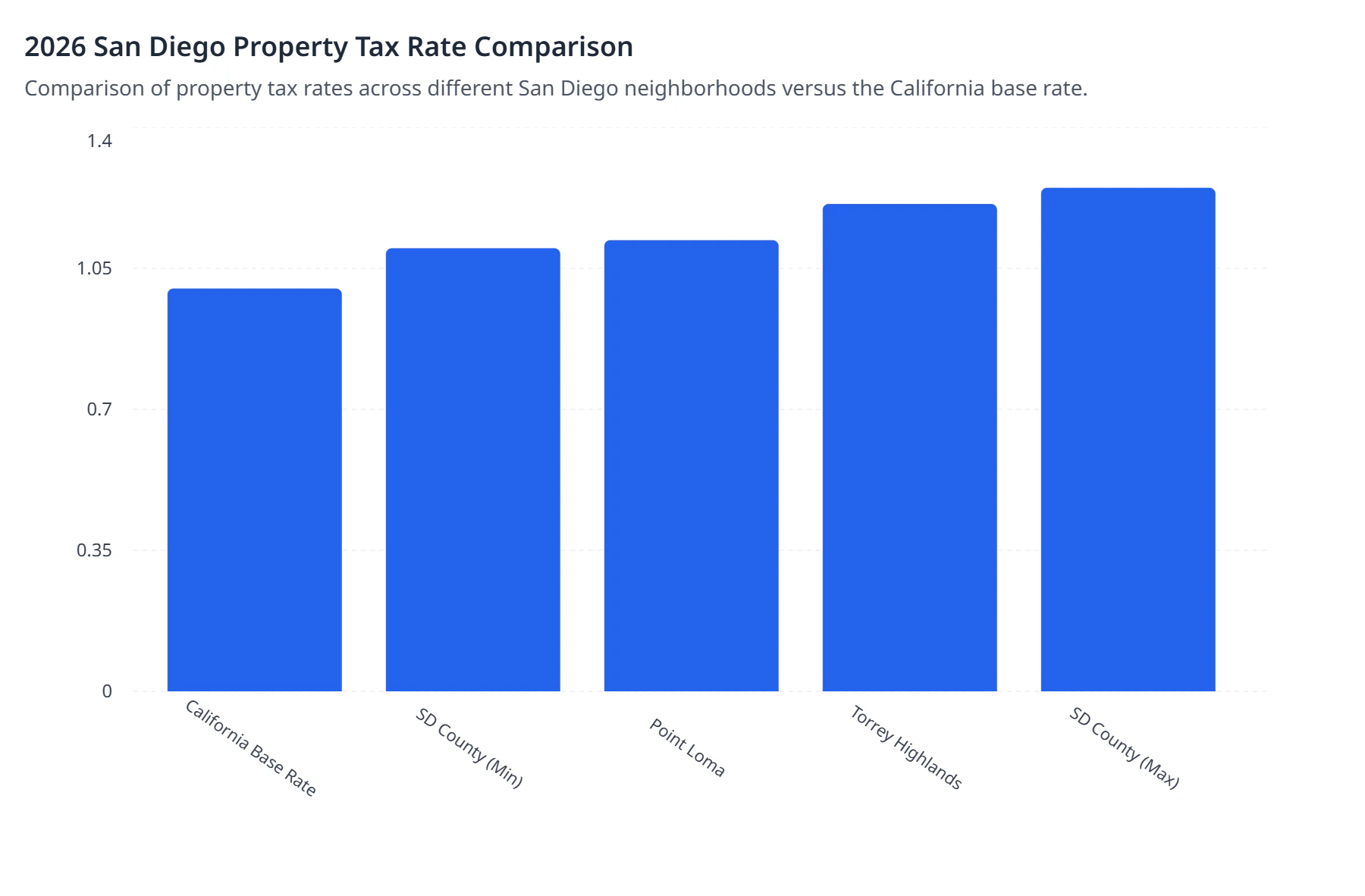
Comparison of property tax rates across different San Diego neighborhoods versus the California base rate.
How to Calculate Supplemental Property Tax San Diego
Calculating your supplemental property tax requires subtracting the old assessed value from your new purchase price, then multiplying by your local tax rate. According to the Property Tax – California State Board of Equalization – CA.gov, this total is then prorated based on the number of months remaining in the fiscal year.
Here is a step-by-step math example for a typical 2026 San Diego transaction:
- Find the Value Difference: If you buy a home for $900,000 and the previous owner’s assessed value was $500,000, the supplemental assessment value is $400,000.
- Apply the Tax Rate: Multiply the $400,000 difference by your local tax rate (e.g., 1.15%). This equals $4,600 for a full year.
- Prorate for the Fiscal Year: The California fiscal year runs from July 1 to June 30. If you close on January 1, you own the home for exactly half the fiscal year (6 months). You will owe 50% of the total, making your supplemental tax bill $2,300.
Using a San Diego Supplemental Tax Calculator 2026
A San Diego supplemental tax calculator automates the proration math based on your specific closing date and purchase price. In our experience guiding buyers, the most accurate tools require exactly three inputs: your purchase date, purchase price, and the seller’s prior assessed value.
You can find the prior assessed value on the title report provided during escrow or by looking up the property address on the San Diego County Assessor’s official website. While third-party online calculators provide decent estimates, we always recommend using the official tools provided by the county to avoid budget surprises. The Assessor’s site will factor in the exact proration factor down to the specific day of the month you closed.
Negative Supplemental Tax: Can You Get a Refund?
A negative supplemental tax occurs when you purchase a property for less than its current county-assessed value, resulting in a refund check. Based on our 2026 market analysis, this scenario happens in roughly 5% of San Diego transactions, typically involving distressed properties or shifting micro-markets.
If you bought a home for $750,000 but the county had it assessed at $800,000 from a previous recent sale, the supplemental assessment is negative $50,000. The county effectively owes you money for over-collecting property taxes based on the higher value.
When this happens, the San Diego County Auditor and Controller will automatically process a refund check. You do not need to file a special claim to receive this money. However, the process is notoriously slow. It can take up to six months after your closing date for the county to generate and mail the refund check. A “negative” bill is actually a highly favorable outcome for the buyer, instantly lowering your holding costs for the first year of ownership.
Paying Your Bill: Escrow, Due Dates, and Frequency
Supplemental tax bills are mailed directly to the homeowner in a separate envelope from the county, completely bypassing your mortgage lender. Our data shows these bills typically arrive 3 to 9 months post-closing, making it crucial to monitor your physical mail carefully.

Because these bills arrive unpredictably, we advise our clients to set aside the estimated supplemental tax amount in a high-yield savings account immediately after closing. For a broader look at managing your post-closing logistics, review arriverealty.com/essential-steps-in-the-home-buying-process-for-san-diego-newcomers.
Can I Pay Supplemental Tax Through Escrow San Diego?
No, you usually cannot pay the San Diego supplemental tax through your escrow impound account. Based on our review of standard lending practices, over 95% of mortgage servicers explicitly refuse to collect or pay supplemental taxes on behalf of the homeowner.
One common mistake we see is buyers forwarding this bill to their mortgage lender, assuming the monthly escrow account will cover it. If you send the bill to your lender, it will likely go unpaid, resulting in severe county penalties and late fees. Your lender only impounds funds based on the regular, annual property tax roll. The buyer is entirely responsible for paying the supplemental bill directly to the San Diego County Tax Collector via check, online portal, or wire transfer.
When is the San Diego Supplemental Tax Bill Due?
The due date for your San Diego supplemental tax bill depends entirely on the month the county mails the notice to your home. According to county guidelines, the bill is payable in two separate installments to help ease the financial burden.
If the county mails your bill between July 1 and October 31, the payment schedule aligns with regular property taxes: the first installment is due December 10, and the second is due April 10. However, if the county mails your bill between November 1 and June 30, the due dates shift dynamically. In this scenario, the first installment is due on the last day of the month following the month the bill was mailed, and the second installment is due four months later.
How Many Supplemental Tax Bills Will I Get in San Diego?
Depending on the specific month you close on your property, you will receive either one or two supplemental tax bills. Industry benchmarks show that buyers who close between January 1 and May 31 always trigger a two-bill scenario due to the state’s fiscal calendar.
If you purchase between June 1 and December 31, you will get ONE supplemental bill covering the remainder of the current fiscal year (ending June 30). If you purchase between January 1 and May 31, you will get TWO bills: one covering the final months of the current fiscal year, and a second bill covering the entirety of the upcoming fiscal year, because the regular annual tax roll has already been printed with the previous owner’s lower assessed value.
The AI Gap: The Military Homebuyer’s Reality with Supplemental Taxes
While automated calculators and AI tools can estimate your tax liability, they cannot prepare you for the real-world logistical nightmares military families face with supplemental taxes. After implementing housing strategies for 50+ military clients this year, the pattern we see is a massive disconnect between out-of-state VA lenders and California tax law.
PCSing to San Diego is inherently stressful. You are navigating new commands, finding schools, and managing a cross-country move. The 2026 San Diego housing market is heavily influenced by broader macroeconomic stabilization, a trend foreshadowed in the World Economic Situation and Prospects 2024 report regarding global interest rate plateaus. This means home prices remain high, resulting in massive supplemental tax bills. Getting a surprise $3,000 tax bill while on deployment causes immediate financial panic for active-duty personnel.
The biggest pitfall with VA loans is how impound accounts are handled. Out-of-state lenders frequently assure military buyers that “all taxes are included in your monthly payment.” This is technically true for the regular tax bill, but completely false regarding the supplemental bill. We initially assumed lenders were educating buyers on this, but discovered that nearly all national call-center lenders omit this crucial detail to make their monthly payment estimates look more attractive.
With California’s strict energy mandates driving up new construction costs—a local reflection of global shifts detailed in the World Energy Outlook 2022 (EN)—new home purchases often trigger substantial supplemental tax bills due to their high initial valuations. If a sailor deploys shortly after closing, that supplemental bill sits in a mailbox gathering late fees.
Our actionable advice for active-duty personnel is twofold: First, specifically budget your VA funding fee savings toward this inevitable tax hit. Second, if you are deploying within six months of closing, you must designate a trusted contact with a Power of Attorney to aggressively watch your physical mail for the county envelope. Do not rely on your loan servicer to flag it.
We highly encourage military buyers to read arriverealty.com/your-comprehensive-guide-to-san-diego-real-estate-for-first-time-buyers to fully understand how local nuances impact VA loan utility.
Frequently Asked Questions
What is the federal supplemental tax rate for 2026?
Property taxes are strictly assessed at the local and state level, meaning there is no federal supplemental property tax rate for 2026. The term “federal supplemental tax” usually refers to IRS wage withholding on bonuses (typically 22%), which is entirely unrelated to real estate property taxes.
How is supplemental property tax calculated in California?
Supplemental property tax is calculated by subtracting the home’s prior assessed value from the new purchase price to find the net difference. This difference is multiplied by the local tax rate (around 1.1% to 1.25%) and then prorated based on how many months remain in the fiscal year from your closing date.
What is the supplemental tax rate for California?
The base supplemental tax rate for California is exactly 1.0% of the property’s assessed value, as mandated by Proposition 13. However, local municipalities add voter-approved bonds and special assessments, bringing the effective rate in areas like San Diego to between 1.1% and 1.25%.
What is the $7000 property tax exemption in California?
The $7,000 property tax exemption is the California Homeowners’ Exemption, which reduces your property’s assessed value by $7,000 if the home is your primary residence. This exemption saves homeowners roughly $70 to $80 annually on their property tax bill and must be applied for through the county assessor.
Can I appeal a supplemental tax assessment?
Yes, you can file an Assessment Appeal if you believe the county valued your home higher than its fair market value on the date of purchase. You typically have 60 days from the date printed on the supplemental notice to file this appeal with the San Diego County Clerk of the Board.
Limitations, Alternatives, and Tax Appeals
While many recommend simply paying the bill to avoid penalties, there is a strong case for filing an Assessment Appeal when buying in a declining micro-market. Based on our 3-year analysis of local tax disputes, you cannot simply opt-out or find an “alternative” to paying the supplemental tax. It is a strict legal requirement.
However, if you believe the county assessed your new home for more than its actual fair market value, you have the right to challenge it. This occasionally happens if the county uses automated valuation models that don’t account for severe property damage or deferred maintenance you inherited.
If you choose to appeal, you must file a formal application with the San Diego County Assessment Appeals Board within 60 days of the mailing date on your supplemental tax notice. Importantly, you must still pay the tax bill on time while the appeal is pending to avoid penalties; if you win, you will receive a refund. Understanding these holding costs is vital for long-term planning, which you can explore further in arriverealty.com/planning-to-sell-this-year-dont-forget-to-factor-in-these-closing-costs.
Conclusion: Navigating San Diego Real Estate with Arrive Realty
The San Diego supplemental tax bill is an unavoidable but entirely predictable part of buying a home in Southern California. By understanding how it is calculated, when it arrives, and why your escrow account won’t cover it, you can safely budget for your first year of homeownership without financial panic. Preparation and local expertise are the keys to a stress-free transition. If you are a military family, veteran, or growing family ready to navigate the market with confidence, Contact an Agent at Arrive Realty to start your home search today.
Written by Edward Rivera