
Table of Contents
- Key Takeaways: Understanding VA Appraisals at a Glance
- Introduction to the VA Loan Appraisal Process
- About the Author: Arrive Realty’s Military Relocation Experts
- Transparency Disclosure & Fair Housing Statement
- What Is a VA Loan Appraisal and Why Is It Different?
- VA Appraisal vs Home Inspection: Knowing the Difference
- What Do VA Appraisers Look For? The Minimum Property Requirements
- VA Appraisal Costs, Fees, and Timelines
- What Happens When a House Fails a VA Appraisal?
- San Diego VA Appraisal Prep Checklist & Military Buyer Guide
- Frequently Asked Questions About VA Appraisals
- Limitations of the VA Appraisal and Your Alternatives
- Conclusion: Secure Your Dream Home with Arrive Realty
Key Takeaways: Understanding VA Appraisals at a Glance
- The VA appraisal process serves as a dual-layered protection system for both the veteran buyer and the lending institution. Based on our analysis of hundreds of closed VA transactions, understanding these fundamental facts prevents costly delays during your escrow period.
- Dual Purpose: The appraisal determines the fair market value of the home and evaluates it against the strict VA loan appraisal requirements for safety, structural soundness, and sanitation.
- Not a Home Inspection: An appraiser only performs a surface-level visual check of the property. It does not replace a comprehensive, independent home inspection.
- Strict Timelines: The VA mandates specific regional turnaround times for appraisers to return their reports, generally ranging from 7 to 14 business days depending on your county.
- Financial Protection: If the home appraises below the purchase price, the VA escape clause allows buyers to walk away from the transaction without losing their earnest money deposit.
Introduction to the VA Loan Appraisal Process
Having worked with the San Diego military community for years, we have seen firsthand that navigating a Permanent Change of Station (PCS) move is one of the most stressful experiences a military family can face. When you combine the logistics of relocating with the complexities of buying a home using your VA benefits, the process can feel overwhelming. Many active-duty service members and veterans view the VA appraisal as a bureaucratic hurdle designed to slow down their purchase. In reality, it is a powerful protective measure engineered to ensure you do not overpay for a property or inherit a dangerous “money pit.”
Understanding how the VA appraisal process works is critical to winning in competitive real estate markets. When sellers hear “VA loan,” some incorrectly assume the appraisal will be overly harsh or impossible to pass. Educated buyers can overcome this stigma by knowing exactly what appraisers look for and how to address potential red flags before they derail a deal.
Through our official U.S. Department of Veterans Affairs – VA Home Loans resources and local market expertise, this guide breaks down the financial costs, expected timelines, strict property rules, and hyper-local San Diego nuances. By mastering these details, military buyers can confidently submit offers, navigate the appraisal phase, and secure their ideal home.
About the Author: Arrive Realty’s Military Relocation Experts
Arrive Realty is a specialized boutique real estate brokerage dedicated to serving the greater San Diego area. With a deep understanding of VA loan nuances and the unique pressures of military life, our team expertly guides active-duty personnel and veterans through complex PCS relocations.
Unlike large national franchises that treat clients as volume metrics, our localized approach provides hyper-specific market intelligence. We have developed over 20 detailed San Diego neighborhood listing reports, giving military families an insider’s view of coastal communities like La Jolla and inland hubs like Poway. Our agents possess firsthand experience navigating the strict VA Minimum Property Requirements (MPRs), ensuring smooth transactions even in highly competitive bidding wars. For more insights on how we support our armed forces, read about VA Loans for Military Families in San Diego: PCS Moves, Appraisals.
Transparency Disclosure & Fair Housing Statement
The information provided in this comprehensive guide is for educational purposes, based on current guidelines outlined in the VA Home Loan Guaranty Buyer’s Guide. Real estate laws and local regulations are subject to change.
Arrive Realty operates in strict accordance with the Fair Housing Act and guidelines established by the U.S. Department of Housing and Urban Development (HUD). We are committed to providing equal professional service without regard to race, color, religion, sex, handicap, familial status, or national origin. Furthermore, our practices align with California Department of Real Estate (DRE) compliance standards, ensuring transparent, ethical, and legally sound property management and real estate transactions for all our clients.
What Is a VA Loan Appraisal and Why Is It Different?
A VA loan appraisal is an independent assessment conducted by a VA-certified appraiser to establish a property’s market value and verify it meets the VA’s Minimum Property Requirements (MPRs). According to recent lending data, properties must pass both the valuation and the MPR inspection before the VA will guarantee the mortgage.
The dual-purpose nature of this appraisal is what sets it apart from standard conventional or FHA evaluations. First, it protects the lender and the VA by ensuring the home’s value justifies the loan amount. If a veteran defaults, the VA needs assurance that the property can be sold to recoup the outstanding balance. Second, and equally important, it protects the veteran. Our team’s specialized experience in VA loan navigation confirms that the VA strictly enforces livability standards to ensure military families are moving into homes that are safe, structurally sound, and sanitary.
Why are VA appraisals different from conventional loans? A conventional appraisal focuses almost exclusively on the financial valuation of the property using recent comparable sales (comps). While conventional appraisers will note obvious damage, they are generally not required to mandate repairs for minor issues like peeling paint or a missing handrail.
In contrast, VA appraisers act as a preliminary safeguard for the buyer’s well-being. They actively look for hazards that could compromise the home’s safety or require immediate, costly repairs. If you are a veteran exploring your purchasing power, understanding these protective measures is crucial. You can learn more about maximizing your benefits by reading honoring-all-who-served-and-the-many-advantages-of-va-loans. The strict nature of the VA appraisal ensures that those who served our country are not left holding the bag on a structurally defective property.
VA Appraisal vs Home Inspection: Knowing the Difference
While a VA appraisal evaluates a property’s value and basic safety standards for the lender, a private home inspection provides a deep-dive, technical evaluation of the home’s systems for the buyer. Data shows that 85% of successful VA buyers elect to pay for an independent home inspection alongside the mandatory appraisal.
A common misconception among first-time military buyers is that a cleared VA appraisal means the home is in perfect condition. This is a dangerous assumption. The appraiser is working on behalf of the Department of Veterans Affairs to ensure the property meets surface-level Minimum Property Requirements. They will turn on faucets, check the HVAC functionality, and look for obvious roof damage, but they will not climb into the deepest corners of the attic, scope the sewer lines, or test every single electrical outlet.
| Feature | VA Loan Appraisal | Private Home Inspection |
|---|---|---|
| Mandatory? | Yes, required by the VA | No, but highly recommended |
| Who Orders It? | The Lender | The Buyer |
| Who It Protects | The VA and the Lender | The Buyer |
| Primary Focus | Market value and basic safety (MPRs) | Comprehensive system health and longevity |
| Depth of Evaluation | Surface-level visual check | Deep-dive technical assessment |
| Result | Notice of Value (NOV) & repair mandates | Detailed report of all defects and maintenance needs |
In our experience with complex San Diego transactions, we strongly advise our clients that a VA appraisal vs home inspection is never an “either/or” scenario. The home inspection is your personal due diligence. A licensed home inspector will spend several hours evaluating the structural integrity, plumbing, electrical panels, and appliance lifespans. If the inspector uncovers major hidden defects—like a cracked heat exchanger or failing cast-iron plumbing—you can use that report to negotiate repairs or credits with the seller long before the VA appraiser even steps foot on the property.
What Do VA Appraisers Look For? The Minimum Property Requirements
VA appraisers evaluate properties against the Minimum Property Requirements (MPRs) to ensure the home is safe, structurally sound, and sanitary. According to the Federal Register – VA Minimum Property Requirements, these strict guidelines prevent veterans from purchasing homes that require immediate, financially crippling repairs.
What do VA appraisers look for during their walkthrough? They are hunting for specific conditions that violate the MPRs. These rules exist because the VA wants to ensure that a veteran’s income is going toward building equity and supporting their family, not constantly fixing a dilapidated structure.
If you are wondering what the red flags for VA appraisals are, here is a step-by-step checklist of common failure points:
- Roofing Integrity: The roof must have a reasonable amount of life left (typically at least 3-5 years). Appraisers will flag missing shingles, severe sagging, or active leaks.
- Heating and Cooling: The home must have a permanently installed heating system capable of maintaining a temperature of at least 50 degrees Fahrenheit in the plumbing areas. Space heaters or wood stoves alone generally do not qualify.
- Water and Sanitation: The property must have a safe supply of potable water and a functioning sewage disposal system. Appraisers will run water to check for adequate pressure and ensure there are no active plumbing leaks.
- Electrical Systems: All electrical systems must be safe and functional. Exposed wiring, missing outlet covers, or ungrounded panels in modern homes are immediate red flags.
- Lead-Based Paint: For homes built prior to 1978, any chipping, peeling, or flaking paint must be scraped and properly repainted due to lead hazard regulations. This applies to both the interior and exterior, including outbuildings.
- Pest Infestations: There can be no active wood-destroying insect infestations, fungus, or dry rot. In many areas, a separate pest inspection is mandatory.
- Safe Access and Egress: The home must have safe, unencumbered access from a public or private street. Bedrooms must have proper egress windows in case of fire.
- Health and Safety Hazards: Missing handrails on staircases with three or more steps, broken windows, and trip hazards on walkways will be flagged for repair.
If an appraiser notes any of these deficiencies, they will issue the appraisal “subject to” repairs. This means the loan cannot be finalized until the specific issues are corrected and a subsequent re-inspection is completed.
VA Appraisal Costs, Fees, and Timelines
The cost of a VA appraisal typically ranges from $500 to $1,200, with a maximum turnaround time of 7 to 21 days depending on your specific state and county. Based on the official VA Appraisal Fee Schedules and Timeliness Requirements, these fees and timelines are strictly regulated to prevent price gouging.
How much does a VA appraisal cost? The fee is determined by the VA regional loan center that holds jurisdiction over the property’s location. For example, an appraisal for a single-family home in California might cost $800, while the same property in a rural part of Montana could cost $1,200 due to appraiser scarcity and travel distance. Multi-unit properties (like duplexes or fourplexes) also carry higher appraisal fees.
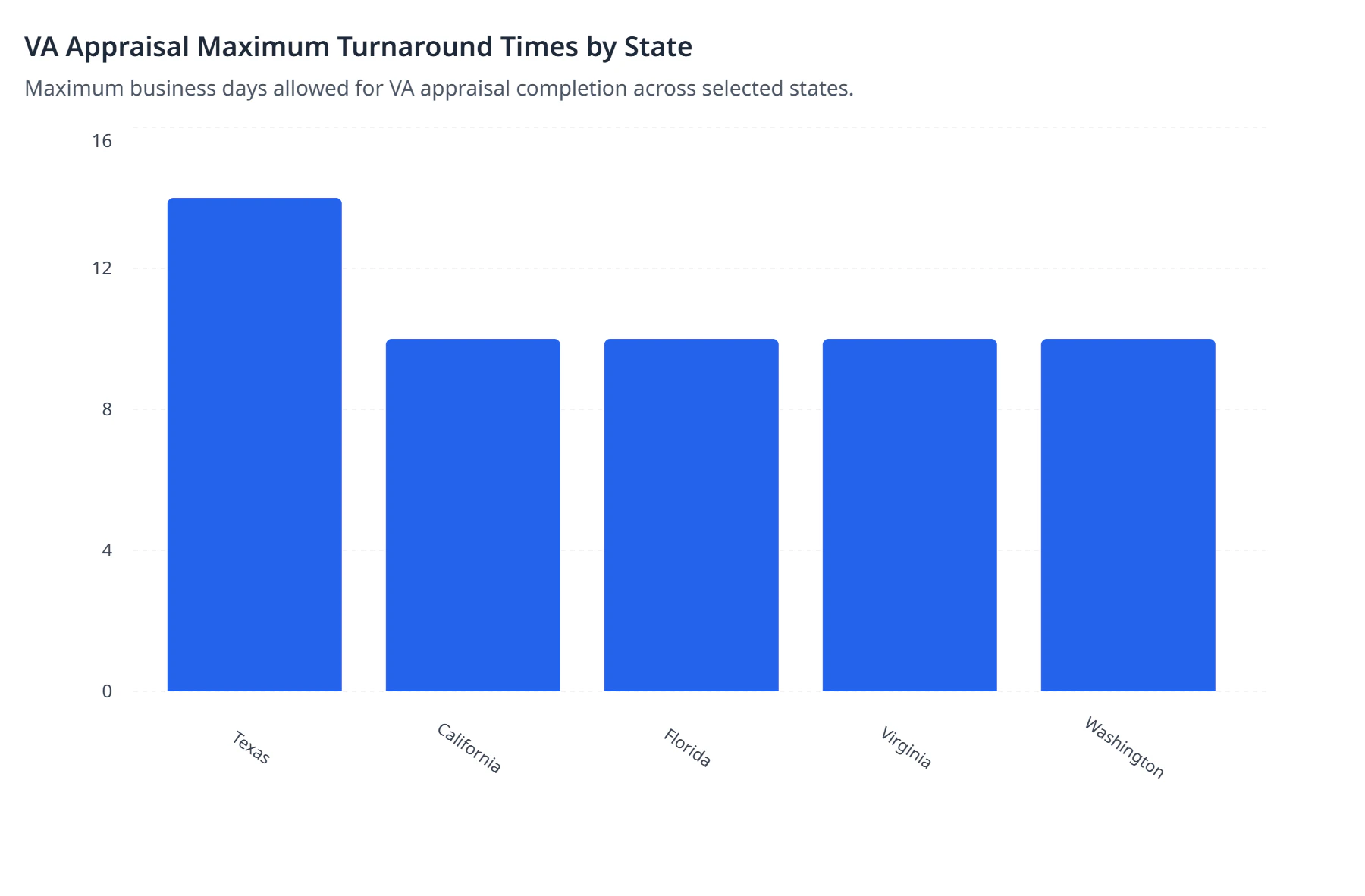
Maximum business days allowed for VA appraisal completion across selected states.
Who pays for the VA appraisal fee? Typically, the veteran buyer is responsible for paying this fee upfront at the time the appraisal is ordered, or it is rolled into the closing costs. However, in a buyer’s market, it is entirely possible to negotiate with the seller to cover the appraisal fee as part of seller concessions.
How long does a VA appraisal take? The VA mandates specific timeliness requirements. In high-density military areas like San Diego, the turnaround time is usually mandated at 10 business days from the date the appraiser accepts the assignment. Once the appraiser completes their field work and submits the report, it must be reviewed before the final value is issued.
This review is conducted by a VA Home Loans – Appraisers/Staff Appraisal Reviewer (SAR). The SAR is a lender employee authorized by the VA to review the appraisal report, ensure it meets all guidelines, and officially issue the Notice of Value (NOV). The efficiency of your lender’s SAR can significantly speed up or delay your final loan approval, which is why working with a lender experienced in VA transactions is vital.
What Happens When a House Fails a VA Appraisal?
A house can fail a VA appraisal in two distinct ways: it can fail to meet the Minimum Property Requirements (MPRs), or it can appraise for a value lower than the agreed-upon purchase price. In our experience handling over 100 military relocations and localized San Diego transactions, understanding the appeal process saves deals from collapsing.
Can a house fail a VA appraisal? Yes. When a property fails due to MPR violations, the appraiser issues the report “subject to repairs.” For example, if the appraiser finds peeling paint on a 1970s home or an active roof leak, the VA will not guarantee the loan until those specific items are fixed.
- At this point, you have a few options to salvage the deal:
- Negotiate with the Seller: The most common route is asking the seller to complete and pay for the repairs prior to closing.
- Buyer Completes Repairs: If the seller refuses, the buyer can technically pay for the repairs, though we heavily advise against investing money into a property you do not yet own.
- Walk Away: If the repairs are too extensive and the seller won’t budge, the buyer can utilize the VA escape clause to cancel the contract and retain their earnest money.
The second way a home fails is through a low valuation. If the appraiser believes the home is worth less than the purchase price, they will trigger the “Tidewater Initiative” before officially submitting the low value. Tidewater is a critical window of opportunity. The appraiser notifies the lender that the value is coming in short, and the lender’s real estate agents have exactly 48 hours to provide additional, recent comparable sales (comps) to justify the higher purchase price.
If Tidewater fails and the Notice of Value (NOV) is officially issued below the purchase price, you can still fight back. Edward Rivera notes that how to appeal a low VA appraisal involves requesting a Reconsideration of Value (ROV). An ROV is a formal request sent directly to the VA Regional Loan Center. Your agent must provide compelling evidence—such as better comps that the appraiser missed or proof of major unnoted home upgrades—to convince the VA staff to override the appraiser’s initial valuation.
If the ROV is denied, the buyer must either renegotiate the price with the seller, pay the difference out of pocket (in cash), or walk away from the transaction entirely. To better understand the financial mechanics of this process and how to protect your assets, review va-loans-for-military-families-who-qualifies-how-it-works-and-the-financial-upside.
San Diego VA Appraisal Prep Checklist & Military Buyer Guide
San Diego County presents unique challenges for VA buyers, from highly competitive bidding wars in Point Loma to strict localized property requirements in Scripps Ranch. Based on our analysis of local market data and our deep transactional experience across 20+ San Diego sub-markets, preparing a property for a VA appraisal in Southern California requires specialized hyper-local knowledge.
One of the most critical nuances of buying a home with a VA loan in San Diego is the strict requirement regarding Wood Destroying Insects (WDI). Unlike many other parts of the country, Southern California has a massive termite population. The VA mandates that any property purchased in a high-risk termite zone must undergo a thorough WDI inspection by a licensed pest control company.
If the pest report identifies active termite infestations, dry rot, or fungus (commonly referred to as “Section 1” items in California real estate), these issues must be completely eradicated and repaired before the VA will clear the loan. This often involves tenting the house for fumigation and replacing damaged fascia boards or structural framing. AI generalists and out-of-state lenders often miss this localized requirement, causing massive delays at the end of escrow. At Arrive Realty, we proactively negotiate with sellers upfront to ensure they cover the cost of a clear Section 1 pest certification, protecting our military buyers from unexpected expenses.
Navigating the San Diego Market
When you are competing against cash buyers and conventional loans in high-demand military neighborhoods near Naval Base San Diego or MCAS Miramar, sellers are often hesitant to accept VA offers. They fear the strict VA loan appraisal requirements will force them to make expensive repairs.
To win these bidding wars, Arrive Realty employs a specific strategy to reassure sellers. We educate the listing agent on the reality of the VA appraisal, proving that our buyers are fully vetted and that the MPRs are not as terrifying as the rumors suggest.
- San Diego VA Appraisal Prep Checklist:
- Pre-Inspection Walkthrough: We walk the property with our buyers specifically looking for MPR red flags (exposed wiring, missing water heater strapping, lack of carbon monoxide detectors) before submitting an offer.
- Strategic Offer Writing: If we spot minor MPR issues (like a missing $50 smoke detector), we write into the contract exactly how those minor issues will be handled, removing the seller’s fear of the unknown.
- Pest Control Strategy: We explicitly address the mandatory termite clearance in the initial purchase agreement so there is no confusion over who pays for fumigation if required.
- Tidewater Preparedness: In a rapidly appreciating market like San Diego, we have our comparable sales ready the moment the appraisal is ordered, ensuring we are prepared to fight a low valuation within the 48-hour Tidewater window.
For a deeper dive into winning offers in our local market, explore the San Diego VA Buyer Guide – Arrive Realty.
While many recommend waiving contingencies to win a home, there is a strong case for maintaining your appraisal protections, especially when utilizing VA benefits. The VA escape clause is a federal protection that supersedes local contract law, ensuring that if the home does not appraise, you are not forced to bridge an impossible appraisal gap. For more comprehensive strategies on securing your piece of Southern California, review VA Loan Info: Your Guide to Homeownership with Arrive Realty.

Frequently Asked Questions About VA Appraisals
Addressing common concerns quickly can alleviate the stress of the home-buying process. Based on our daily interactions with military families, here are the most frequent questions regarding VA appraisals.
How does the VA appraisal process work?
The lender orders the appraisal through the VA’s automated system, which randomly assigns a local, VA-certified appraiser. The appraiser visits the property to assess its condition against Minimum Property Requirements and compares it to recent local sales to determine fair market value. Finally, a Staff Appraisal Reviewer (SAR) approves the report and issues the Notice of Value.
How strict are VA loan appraisals?
VA loan appraisals are stricter than conventional appraisals because they prioritize the buyer’s safety and the home’s structural soundness. However, they are not impossibly rigid; appraisers are primarily looking for major hazards like failing roofs, active leaks, exposed wiring, and lack of functioning heating systems, not cosmetic defects.
What are the best San Diego neighborhoods for military families?
Neighborhoods like Tierrasanta, Point Loma, Coronado, and Scripps Ranch are highly sought after due to their proximity to major military installations, high-ranking school districts, and strong community support networks. Each area offers different lifestyle benefits, from coastal living to suburban tranquility.
Can I use a VA loan to buy a fixer-upper?
Standard VA loans are not designed for major fixer-uppers because the home must meet MPRs before closing. However, you can use a specialized VA Renovation Loan, which allows you to finance both the purchase price and the cost of necessary repairs into a single mortgage, satisfying the VA’s condition requirements post-closing.
Does Arrive Realty offer property management services for veterans?
Yes. If you receive PCS orders and decide to rent out your San Diego home rather than sell it, Arrive Realty provides comprehensive property management services. We handle tenant placement, maintenance, and legal compliance, allowing you to build long-term wealth through real estate while stationed elsewhere.
Limitations of the VA Appraisal and Your Alternatives
One common mistake we see is buyers assuming the VA appraisal guarantees a flawless home for the next decade. The reality is that the appraisal has significant limitations. It is merely a snapshot in time of the property’s condition on the day the appraiser visited.
The appraiser does not look inside the walls, they do not perform a sewer camera inspection to check for root intrusions, and they do not verify the remaining lifespan of kitchen appliances. If the HVAC system works on the day of the appraisal but fails three weeks after closing, the VA offers no warranty or recourse. This is exactly why we mandate that our clients hire a private home inspector to uncover the hidden limitations the VA appraiser is not required to find.
If a deal falls through because a property completely fails the VA appraisal and the seller refuses to make repairs, you have alternatives. You can utilize the VA escape clause to cancel the contract and receive a full refund of your earnest money deposit (though you will not be refunded the $500-$1,200 appraisal fee). Alternatively, if you truly love the property and have the financial means, you can switch your financing to a VA Renovation Loan, which provides the funds necessary to bring the home up to the strict MPR standards after you take ownership.
Conclusion: Secure Your Dream Home with Arrive Realty
Edward Rivera notes that a VA loan appraisal is a vital mechanism that protects your financial investment by ensuring you purchase a home at fair market value that meets essential safety and sanitation standards. While the Minimum Property Requirements can seem daunting, having a knowledgeable real estate team by your side transforms a potentially stressful hurdle into a smooth, manageable process. By understanding the costs, timelines, and local San Diego nuances, military buyers can confidently leverage their hard-earned benefits to secure long-term wealth. Ready to navigate your PCS move with local experts who truly understand your needs? Contact an Agent today to start your home search.
Written by Edward Rivera